

REVENUE ATTRIBUTION SPECIALIST | B2B MARKETING INFRASTRUCTURE
You know marketing is working. You just can't prove it.
I build the attribution infrastructure that shows exactly what's driving pipeline — so you walk into every leadership meeting with numbers you trust.
When HubSpot and Salesforce don't agree, nobody wins.
Sales rejects leads marketing worked hard to generate. Leadership questions budget. Your team loses confidence in the numbers. And you spend more time defending spend than driving strategy.
That's not a tools problem. That's an infrastructure problem. And it's fixable.

About CY Growth Solutions
Most marketing ops consultants tell you what to fix. I build it.
I've built attribution infrastructure at enterprise scale — from zero at Alfa Laval (128% CPA reduction, 68% lead-to-opportunity improvement, $200K saved) to post-merger unification at Summit (40% CPL reduction in 90 days).
SQL Server certified. HubSpot and Salesforce native. Twenty-five years connecting marketing data to revenue decisions.
If your team is executing but leadership can't see the impact — that's exactly what I fix.

How I help

Attribution Infrastructure
First-touch, last-touch, and weighted models built and implemented — not just recommended

Lead scoring
Scoring models that reflect actual buying signals, not just activity

CRM & MAP Integration
HubSpot, Salesforce, Marketo, and Dynamics 365 connected and talking to each other

UTM Governance
Standardized tracking so every campaign is measurable from click to closed deal

Executive Dashboards
Revenue reporting leadership actually trusts

Attribution Diagnostic
Revenue reporting leadership actually trusts
How I work
1. Audit what's actually happening.
I map your full attribution infrastructure — tracking, CRM fields, MAP integrations, UTM governance, and reporting — so we're working from fact, not assumption.

2. Identify where attribution breaks down.
Every gap, sync failure, and data quality issue gets documented and scored. You see exactly where revenue visibility is being lost and why.
3. Fix the highest-impact problems first.
We address what's costing you the most — bad data, broken integrations, missing attribution — before moving to optimization and reporting.
Who I work with

Good fit:
B2B companies with $500K+ marketing spend and no clear ROI story
New CMO inherited broken or fragmented systems
Post-merger companies running HubSpot and Salesforce in parallel
RevOps team exists but serves sales — marketing attribution is an afterthought
Leadership is questioning the marketing budget
Not a fit:
You need campaign execution, content, or ads management
You're pre-revenue or under $250K marketing spend
You want a recommendation deck, not implementation
See the work.
Real deliverables from real engagements. Click to see exactly what you get.
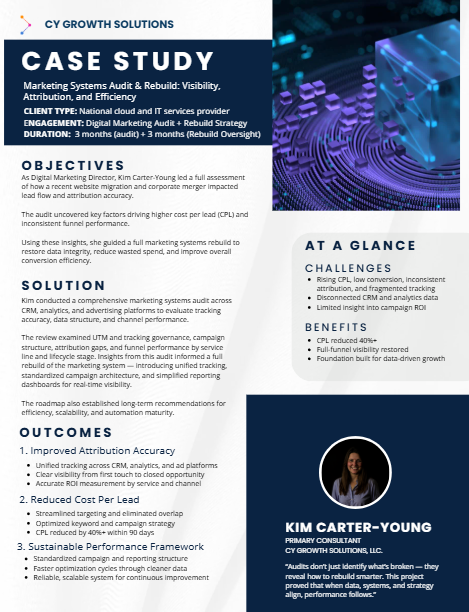
System & Data Clarity Audit
Phase 1 findings for a post-merger B2B company. Scored across 7 dimensions with a prioritized roadmap.
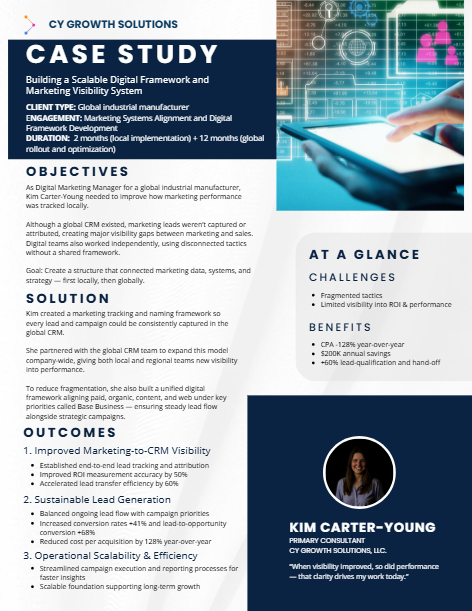
Digital Framework & Attribution Build
How a global industrial manufacturer went from zero attribution to 128% CPA reduction.
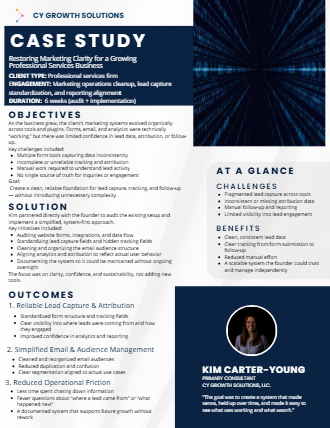
Audit, Segmentation & Rebuild
Full lifecycle audit with segmentation strategy and implementation roadmap.
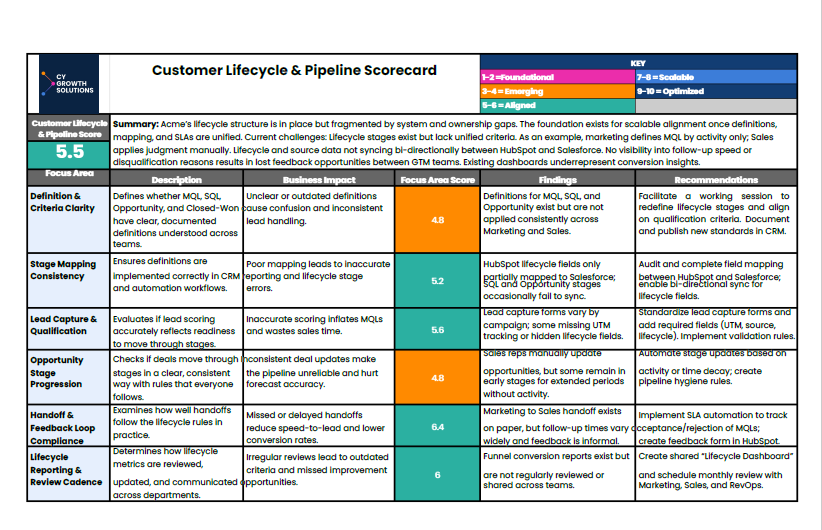
System & Data Clarity Audit
Phase 1 findings for a post-merger B2B company. Scored across 7 dimensions with a prioritized roadmap.
Every week without attribution clarity is a week of budget you can't defend.
Let's find out what's broken and what it's costing you.
Common Questions
-
RevOps is built around the sales motion — pipeline visibility, forecasting, and CRM hygiene for Sales. Marketing attribution infrastructure — UTM governance, lead scoring logic, lifecycle stage definitions, first and last touch mapping, and the reporting that connects marketing spend to closed revenue — sits within RevOps in theory. In practice, it's almost always deprioritized against sales-facing work. The marketing attribution layer ends up ownerless, incomplete, or built just well enough to report activity without connecting it to revenue. That's the gap I fill.
-
Yes — and it's often the best time. Building a marketing ops function is time-consuming, and the foundational work — attribution infrastructure, governance, lifecycle definitions, system configuration — almost always gets deprioritized against day-to-day demands. I work alongside the team to build the foundation they're already planning, get it done faster, and free them to focus on execution instead of being pulled in every direction at once. I also act as another set of eyes — helping establish the infrastructure, governance, and operating model that gives a new function something solid to build on, rather than spending the first year untangling what was set up quickly.
-
That's worth exploring. "Covered" usually means GA4 is installed and there's a dashboard somewhere. What it rarely means is a complete chain — UTM parameters governed consistently across every channel, CRM fields mapped correctly, lead scoring tied to lifecycle triggers, first and last touch reconciled across systems, and executive reporting that traces a closed deal back to its original source. There's almost always a gap between what marketing believes is tracked and what Sales and leadership can actually see. I'm not trying to replace what's working — I'm trying to find where the chain breaks.
-
AI is a pattern matcher. It works with the data it's given — it can't tell you what's missing, what's being tracked incorrectly, or where your systems are siloed. In most B2B marketing stacks, the data is incomplete before AI ever touches it. Inconsistent UTMs, broken CRM sync, untracked activities, ungoverned fields — AI builds confidently on top of all of it without flagging any of it. The result looks like an answer but reflects your gaps back at you. The foundation has to be right first. That's the work I do — and it's also what makes AI actually useful once it's in place.
-
Both — depending on what the engagement calls for. The diagnostic gives CMOs and VPs exactly what they need to make the case internally — a scored assessment of what's broken, what it's costing, and a prioritized roadmap for fixing it. From there, some clients implement with their internal team. Others bring me in to lead or support the implementation directly. Either way, the decision gets made with full visibility into the problem.